Has your furry child ever experienced redness between his toes, frequent licking of the soles of his feet, and a peculiar smell? If there is, then the shoveling officials should pay attention to the fact that the dog is likely to suffer from interphalangeal inflammation. What kind of disease is this? Follow Dr. E to find out.

What is interphalangeal inflammation?
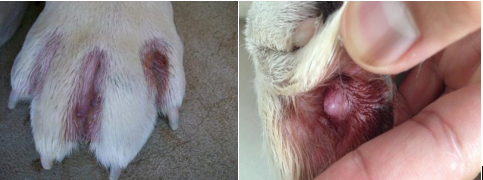
Interdigital Pyoderma, also known as Pododermatitis, is a deep bacterial infection of the paw. Simply put, the dog's toe gap and the deep foot gap are infected and inflamed, which is interphalangeal inflammation. Clinically, it has a high incidence and is one of the common skin diseases in dogs.
Symptoms of interphalangeal inflammation
The main manifestations of sick dogs are licking, biting the affected part, or pain and lameness of the affected limb, swelling, hair loss, pustules and so on.
Causes of interphalangeal inflammation
This disease is mainly secondary infection. There are many possible causes, such as bacterial infection, parasitic infection, atopic dermatitis, trauma or hormonal abnormalities, immune diseases, foot dampness and infection, etc. The common causes are as follows:
1. The dog is kept in a cage for a long time, or the place where the foot pad touches is wet;
2. Not regularly trimming nails and sole hair, too long hair, hot and humid weather can also cause interphalangeal inflammation;

3. Wet the soles of the feet after going out for a walk or not dry them in time after washing the feet at home;

4. Go out to play and accidentally abrade the soles of the feet, and the trauma is not treated in time, resulting in infection, thus forming interphalangeal inflammation.
Some short-haired, heavy dog breeds with deformed feet are more prone to stubborn interdigital pyoderma and furuncles, such as bulldogs, Shar-Peis, golden retrievers, Labradors, and mastiffs. Because of many causes, the disease is easy to recur.
Treatment of interphalangeal inflammation
Mild infection, local redness, swelling, etc., can be used externally as antifungal spray or anti-inflammatory ointment, as well as general spray for skin diseases. Insist on daily use.
Pustules or pustules between toes have been broken and ulcerated, requiring medical treatment, external use of drugs after debridement and disinfection, and foot bath for treatment.
In order to prevent the dog from licking and biting, an Elizabeth ring and a muzzle can be used externally.

Prevention of interphalangeal inflammation
1. Use a pet fence instead of a cage when the owner is not at home, which can not only restrict the dog's activity area, but also not cause interphalangeal inflammation;
2. Regularly repair the dog's sole hair and keep it dry;
3. If you want to clean dog's foot pads after walking home, you must use a hair dryer to dry the hair on the soles of your feet to prevent interphalangeal inflammation.
4. Go out to walk the dog home and carefully check whether the dog's foot pad is injured. If the wound is found, it should be disinfected in time to avoid infection.
5. Obese dogs need to control their diet reasonably and increase their exercise appropriately to avoid suffering from interphalangeal inflammation due to excessive weight.