Little friends that grizzly bears have met
When the grizzly bear was 3 to 4 months old, we began to take her downstairs for a walk. During the walk, she met many small companions: several puppies in the community, cats in the community, puppies on the road at night, etc., but each time they sniffed each other for a short time and then separated from each other.
I will be 8 months old soon, and I still haven't played with one or several puppies for a long time. Until a few days ago, when I went to play in the neighboring community, I met a very docile puppy. When I saw the grizzly bear wanting to come forward but not knowing how to play with the same kind, I realized that making friends with the grizzly bear should be on the agenda.
After inquiring about the daily activity time and range of the gentle dog, I took the grizzly bear to the neighborhood again according to the corresponding time. Surprisingly, there was another dog playing in the play area this time.
Watch and learn ing
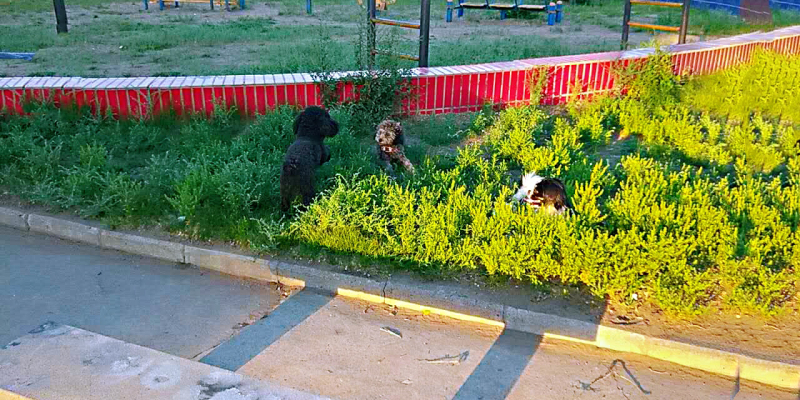
The little grizzly bear, who had just arrived at her destination, was a little confused. She was not very good at getting along with her own kind. She was a little shy and a little afraid. She chose to watch and watch the other two dogs play. After a period of observation, and with my encouragement, the grizzly bear successfully took the first step to play with his friends.
Join the fighting
After a few minutes of watching and preparing, the grizzly bear is finally ready to join the battle ~ (≧ ≧ ≦)/~ la, the little grizzly bear who is learning step by step is super cute ~
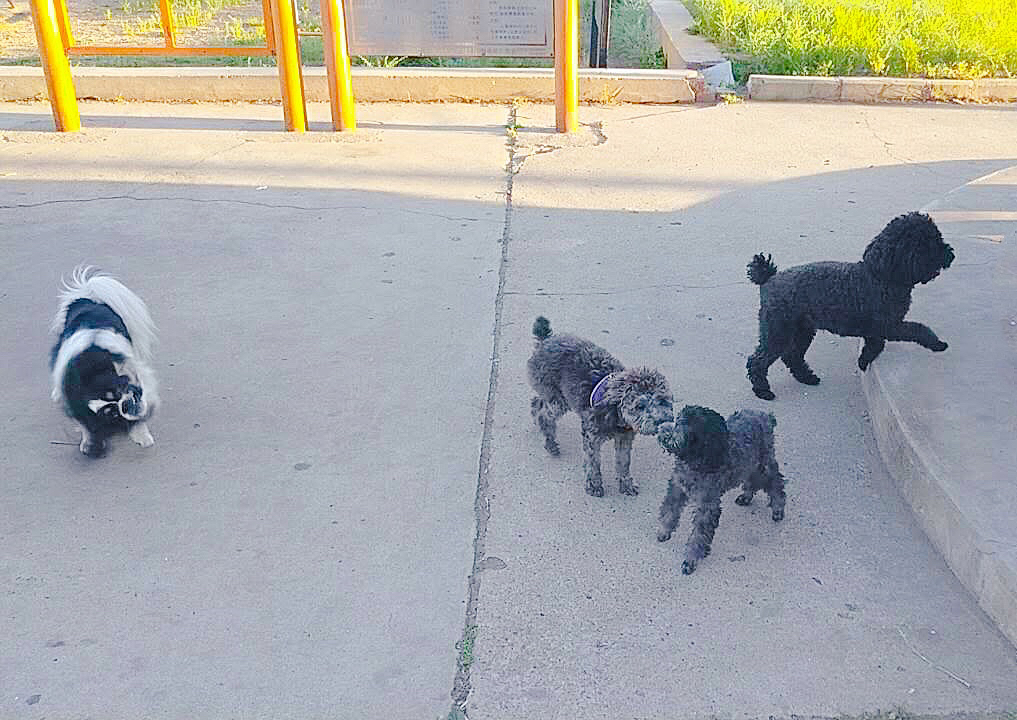
In the course of the game, the little grizzly bear was super happy. After a short rest, a new dog came to join the battle! A 3 month old gray poodle and a 2 month old black poodle, both super docile ~
Through the smell of each other, after getting to know each other, quickly started a new battle ~ After a super long seesaw battle, Grizzly Bear children's shoes learned to take the initiative to attack, congratulations, clap!
Forward training
Choose the right playmate.
For the first time to learn to play outdoors for a long time, learning partners (teachers) are very important. Try to choose dogs with docile personality and similar body shape. The size difference is too big, it is not convenient to play together, strong personality of the dog is often easy to accidentally hurt; grizzly bear is very smart, she met when she got out of bed when she was a child, now even if it is easy to get out of bed but still dare not, so, if the first outdoor play was accidentally hurt, then it is easy to have a rebellious mentality. It's better to prepare for observation in advance and start playing for the first time with the right partner at the right time and place. After learning to socialize, you can relax the restrictions and let the dog freely choose playmates to socialize ~ \ \ (≧ ▽ ≦)/~ la la la
Let go of the traction
At the beginning of the play, because of all kinds of worries, I still gave the grizzly bear a lead, but it was really inconvenient (; ´ `). I made up my mind (the grizzly bear is also very obedient in daily life) and let go of the lead rope. As expected, the grizzly bear began to socialize more smoothly.
Timely reward
After the grizzly bear finished the first stage of playing with two dogs, Dad took out the dog food in time to reward him. The grizzly bear really liked to play with his companions.
However, this kind of reward still needs to be moderate. During the second long play, the grizzly bear asked me for food again. I relented and gave it to her. She began to circle around me with her friends.
Precautions
Don't interfere too much with your dog's social life.
After meeting a new friend, the dog's simple excitement and excitement do not need to be disturbed by the shoveling officials; at this time, the dog needs to be completely relaxed, do not interfere when sniffing each other, give them quiet space, the more interference, the more anxious the dog is, the more it does not know how to say hello correctly. Just wait for her gentle dog to teach her the right social etiquette.
Make social friends as early as possible
Looking at the data, it is found that socialization is most likely to be successful when it begins early in the puppy's life. Start the puppy socialization process as early as possible. This basic training teaches the puppy how to keep himself in good shape in a busy state. Of course, this kind of friendship must be started after the dog is immunized against canine parvovirus and canine distemper.
Read dog social behavior
When two strange dogs meet freely without a guide, they spend some time getting to know each other. Dogs will first stand up straight and then approach each other slowly and carefully, often in indirect circles; direct approaches are often interpreted as threatening movements. Get close and sniff each other. Smell the head and face first, then the genital area with the strongest smell. Then the dog may walk away. The communication is over or one of the dogs tries to start the game. She raises her front paws in the air, leans down her front body or barks to invite her to play together. Game-style fights may seem crude, but they are clearly conducted according to their social norms, with no heavy biting and few obvious dominant behaviors.
Don't be nervous or overly intrusive in this process. Just watch. My approach is to let the grizzly bear feel that I am around and take a positive attitude towards her social interaction.
The body language of a dog is similar to that of a wolf. When she is quiet and peaceful, her body posture is relaxed, her face is calm, her ears remain in the normal position, her tail is drooping, her body is not arched or raised, her eyes are slightly closed, and her lip and neck muscles are relaxed. When she is confident and wants to show her authority and dominance to another dog, her body is slightly arched and ready for action. So when a grizzly bear arches up, it doesn't necessarily mean she's afraid, it may also mean she's confident to "beat" other dogs.